Orbital Cognitive Substrate
HARDRONUS
When the solar panel becomes the computer
scroll
Orbital Cognitive Substrate
When the solar panel becomes the computer
The Problem
The rise of artificial intelligence has created an unprecedented demand for computing power and energy — one that is growing faster than Earth's infrastructure can absorb. Power grids, cooling systems, and land for data centers are becoming the bottleneck. The solution may not be on the ground at all.
Core Idea
If every solar panel were also a computer — the computing system becomes simpler and lighter by several times.
In classical space architecture, a solar panel is infrastructure — it powers something else. Hardronus inverts this entirely. The photovoltaic surface is the compute substrate.
The fundamental unit — the Hardron — is a compact cell that generates energy, computes, stores state, and communicates with its neighbors — without a separate external power source or discrete compute payload. Each Hardron operates as part of a larger orchestrated orbital system.
Radiation-resistant Hardrons are built on gallium arsenide (GaAs): the photovoltaic layer and the compute-and-memory block are integrated into a single structure.
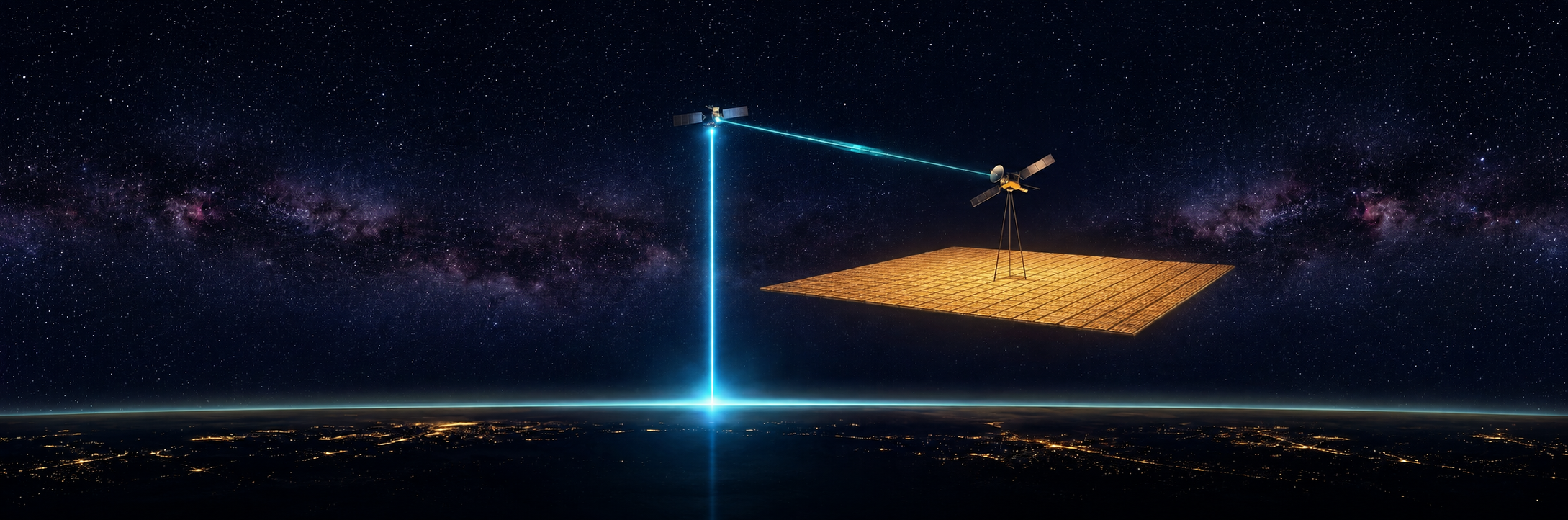
Millions of Hardron cells form a Domain. Domains orbit in coordinated Clusters. Together they constitute Hardronus: a distributed orbital compute substrate, sustained by sunlight-driven computation.
System Hierarchy
01 / base unit
Hardron
Autonomous radiation-resistant photovoltaic compute cell. Energy generation, neuromorphic processing, MRAM state storage, and mesh communication in a single compact module.
02 / node
Domain
Millions of Hardron cells forming a single flat orbital structure, managed by a DSN satellite. Designed to execute a significant, bounded portion of computation within one illumination window.
03 / plane
Cluster
Multiple Domains on a shared orbital plane, coordinated to maintain continuous computation across light and shadow cycles through scheduled task handover.
04 / network
Hardronus
The global orbital compute complex. An ensemble of Clusters forming a planet-scale orbital AI infrastructure with high-bandwidth links to Earth.
DASEC Standard
Photon-to-Logic
Photocurrent drives logic gates directly, without intermediary conversion. Compute intensity scales dynamically with solar flux.
In-Memory Computing
Neural weights reside inside the compute structure itself. No memory bus latency. Minimal heat dissipation.
MRAM Snapshot
Full state capture to non-volatile MRAM before shadow entry, powered by capacitive buffer. Instant resume on sunlight return.
Contactless Mesh
Inductive near-field communication between each Hardron and its four neighbors. No wiring. High fault tolerance. Scales with domain size.
Radiative Balance
The entire Hardron surface acts as a passive radiator. Stefan–Boltzmann radiation dissipates heat proportional to T⁴ — no active cooling required.
Orbital Handover
Tasks are sized to fit within a single illumination window. Before shadow entry, a Domain transfers completed results, prepared checkpoints, and selected active task context to the next illuminated Domain.
Why Orbit
Abundant solar energy. Natural vacuum cooling. No land. No weather. No grid. For many AI workloads, orbital latency is secondary to compute density and energy availability.
A Domain is the orbital equivalent of a server rack. A Cluster is a data center. Hardronus is the distributed cloud — except it runs on sunlight, beyond many terrestrial infrastructure constraints: power grids, cooling capacity, land availability, geographic concentration of risk.
Many AI workloads are compute-intensive and can tolerate relatively modest external data exchange compared with the scale of internal computation. A query goes up, an answer comes down — while the primary computation is performed in orbit using sunlight as the energy source.